
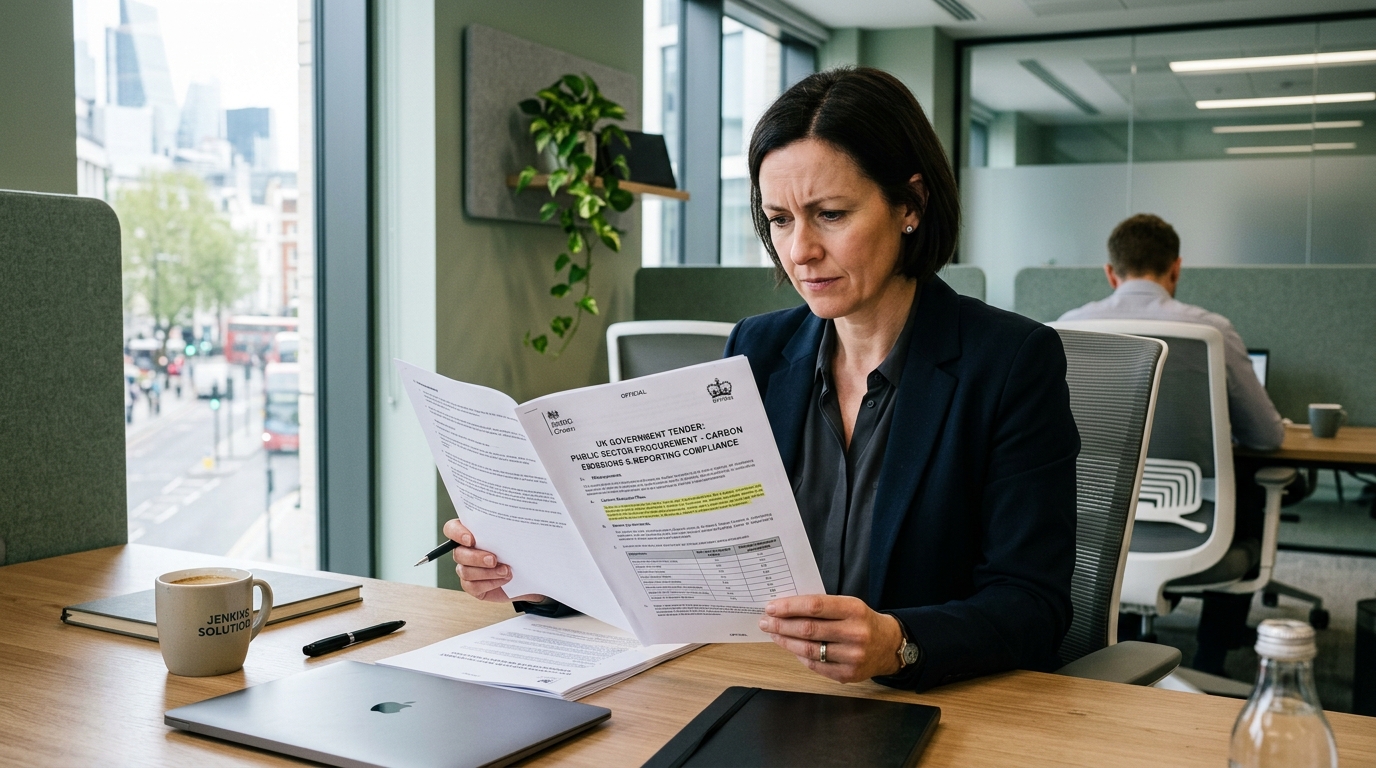
There is a specific moment that happens to almost every growing business the first time they go after a public sector contract. You have done the work, you know you can deliver, and you finally get your hands on a tender pack for a local authority framework or an NHS supply contract worth anywhere from £200,000 to £2 million. Then you see it buried in the compliance section: bidders must submit a Carbon Reduction Plan in line with PPN 06/21.
The excitement drops fast. Suddenly you are staring at a blank template with no idea which emissions data you actually need, trying to remember whether your mileage logs are in one spreadsheet or three, and wondering whether Scope 3 figures are optional or mandatory. The data gathering is hard enough. What makes it worse is the quiet fear that even if you do pull something together, it will be rejected on a technicality - and you will have to walk away from a contract you are genuinely qualified to win.
That is the moment I kept hearing about when I started talking to small contractors, consultancies, and service businesses who were trying to compete in public procurement. They were not losing on price or capability. They were self-selecting out of tenders before they even started, because the carbon reporting requirement felt insurmountable.
I built CarbonVerified because I could see the problem clearly and the existing solutions were all wrong for this audience. Enterprise ESG platforms are built for large corporates with sustainability teams and five-figure software budgets. A £2 million turnover business does not need that. They need a guided pathway that takes them from zero to a compliant, submission-ready document - ideally in the same afternoon they discovered they needed one.
The process we built is deliberately straightforward. You start by entering your operational data: energy consumption, fuel use, business travel. You do not need an environmental science background to do this - the platform tells you exactly what to enter and where it comes from. From there, CarbonVerified maps your figures directly to the PPN 06/21 reporting standard, handling the aggregation across Scope 1, 2, and the relevant Scope 3 categories automatically. Nothing falls through the cracks because the structure enforces completeness. At the end, you get a Carbon Reduction Plan that is formatted, compliant, and ready to attach to your tender submission.
The difference that makes in practice is significant. Businesses that had written off a tender on a Monday afternoon are submitting a complete plan by Friday. More importantly, they are submitting it with confidence - not with that nagging worry that a procurement officer is going to bounce it back on a technicality. For contracts in the £500,000 to £2 million range, that confidence is worth a great deal.
I want to be clear about what CarbonVerified is not. It is not a shortcut past genuine sustainability. The plan it produces reflects your actual operational data, and it includes the forward-looking commitments that PPN 06/21 requires. What it removes is the process friction - the blank-template paralysis, the spreadsheet archaeology, the uncertainty about whether you have interpreted the standard correctly.
If you have opened a tender pack recently and quietly closed it again because of the carbon reporting requirement, that is exactly who CarbonVerified is built for. Take a look at how the platform works - if it fits your situation, you can have a compliant plan ready well before your submission deadline.
Ready to simplify your carbon reporting?
Join hundreds of UK SMEs using CarbonVerified to stay compliant and competitive.
Get Started for Free

